Pages

Saturday, February 2, 2013

Everybody loves a good drought

A few weeks back, I attended a talk by P. Sainath on his plans for  a 'Rural archive of India'.

His idea is to have an archive of digital content like videos and pictures and have them accessible in a wiki style website. Ofcourse, he would be the editor and quality czar but anybody would be able to contribute.

He showed some photos and videos on his travels to the parts of India that most people brought up in towns cannot even comprehend. Most of the material was about 'people at work'. A potter from West Bengal, a martial art instructor in Kerala, a dance form in U.P, pictures of farmers in Vidharbha.

Here are my thoughts from the talk:

What is the practicality of these artifacts? 
How do these people at work derive meaning from life? - Some of them are clearly just trying to survive but some had passion. 
Most people do what they do because they don't have a choice - Like the potter who said that if his kid doesn't do well at school, he would become a potter too.
What can we do about it? 
Quality of life - Does the struggle of life bring out a certain character in people? 
When people in the city think about villages, there is a romanticism about it. However, the truth is that village life is full of hardships and most villagers would want to migrate to cities to live a 'better' life. At-least it is one up on the Maslow's hierarchy where your physical needs are taken care of. 
If say a tribe of a unique profession give up their unique work and move to the city and eventually climbs the ladder of opportunity in a more mainstream business, should we feel bad that the their uniqueness is lost Or should we celebrate their success? 
What are some perpectives on life that you gained as you travelled into the heartlands?

Should add this book to my reading list where perhaps I will get some answers:
Everybody loves a good drought.

Sunday, December 9, 2012

Inner peace

Working on a project that is tagged as 'social impact', I often think whether you can do good without being good yourself.

For instance, can you do charity without having any expectations? Are you good to people who beneath you in the pecking order?

If not, then you are doing it for the wrong reasons. People don't WANT your charity if you are doing it to massage your own ego.

This TED talk called "Shut Up and Listen" therefore struck a chord with me. It says any social work that is not aligned with the interests of the people you are trying to help is doomed to fail. But it also talks about the patronizing nature of the 'giver' which forbids him from 'listening' to the people he is trying to help.

Without being good yourself and without eliminating the ego you can never do social good.
A personal transformation is required before you set out to transform others. You have at peace with the world and more importantly with yourself.

That is a journey I want to begin.

Monday, November 5, 2012

Frictionless Serendipity

This article lamenting on how social media tools like Facebook make us miserable struck a chord with me.  I have been noticing the same for the past many months. What was a tool to share ideas and personal news has turned out to be a competition to capture attention.

But my take is that this experience is but a speed bump to the future. Where, it is not only sharing that is frictionless but also serendipity.

Clearly, we are creating more information about ourselves than we ever have. The photos we take, the places we visit, the songs we listen, the ideas we have, the books we read, the movies we liked, are all getting logged in some database. And a lot of this sharing is already frictionless. Maybe even a little too much (privacy).

The next problem is to make serendipity also frictionless. Currently, I need to visit my Facebook page to see what I am missing out on (fear of missing out). But instead, if serendipity was pushed when its needed, it would be more useful. If I search for a book, I want to see what my friends felt about it. My playlist should also weigh what my friends have been listening.  

Google Social Search is promising in this regard but it doesn't have the social data from Facebook. iPhone's Siri is another potential interface for frictionless serendipity.

So, until the serendipity engine is built and calibrated correctly, hold on to your seat belts. oops. News Feed.

Sunday, September 18, 2011

The Left is Right

The recent survey that listed most Mallu cities as the best places to live in India, while echoed my own assertions, is not something Keralites need to be proud of. Yes, we are better than the rest, but we were a lot better in 'the good old days'.

It could be argued that poor infrastructure, overcrowding and traffic conditions in Tier 1 cities, elevated the Tier 2 cities to a higher level. But the example of Chandigarh, which is a planned city, shows that the reason might be something else.

If the survey shows anything, it is that higher incomes do not necessarily lead to higher life satisfaction. With greater wealth, comes greater responsibility and I suspect most people are ill equipped to handle their high disposable incomes. 'Keeping up with the Joneses' is hard when everyone else is also at it.


The wrong kind of growth
Kerala is fast losing its charm and greenery thanks to excessive commercialization of Real Estate and ever increasing consumerism. It has been well known for a while that the Gulf money and the IT coolies are ruining the state. Whatever few playgrounds and empty pockets of land there was in this  densely populated state is being eaten away by the apartments and shopping malls. Ofcourse, it is unreasonable to expect the Govt to provide a decent standard of living while they are co-conspirators along with the Land Mafia. But it has always amazed me that shopping malls have become an obsession and the favorite time pass of a populace that is living in what is one of the 50 most beautiful places to visit in the world. (Fort Kochi remains one of the few places  insulated from the perils of urbanization). I can also never understand how people can accumulate so much junk without even considering for a moment the impact of it all.


It is in this light that ideas like Gross National Happiness in favor of GDP although they sound whacko, seem to  be in the right direction. Not only as a country but also as a society and an  individual.

But you need transformational leaders for that kind of change which is a shame to think in a state whose Kings shunned lavish lifestyle and put away wealth for future generations.

So, the other alternative is to undo whatever damage that the commerce has brought to the state. And what better way to do it than elect an ideologically heavy Left govt. that is anti bourgeoisie?

Saturday, September 17, 2011

It is all there is


The New Yorker has an interesting piece on the void that secularism creates in the pursuit of a purpose driven life. While it explores several ideas from Darwin to religious texts, I think Einstein offered a better perspective.

What an extraordinary situation is that of us mortals! Each of us is here for a brief sojourn; for what purpose he knows not, though he sometimes thinks he feels it. But from the point of view of daily life, without going deeper, we exist for our fellow-men--in the first place for those on whose smiles and welfare all our happiness depends, and next for all those unknown to us personally with whose destinies we are bound up by the tie of sympathy. A hundred times every day I remind myself that my inner and outer life depend on the labours of other men, living and dead, and that I must exert myself in order to give in
the same measure as I have received and am still receiving.

To inquire after the meaning or object of one's own existence or of creation generally has always seemed to me absurd from an objective point of view.
 And yet everybody has certain ideals which determine the direction of his endeavours and his judgments. In this sense I have never looked upon ease and happiness as ends in themselves--such an ethical basis I call more proper for a herd of swine. The ideals which have lighted me on my way and time after time given me new courage to face life cheerfully, have been Truth, Goodness, and Beauty. Without the sense of fellowship with men of like mind, of preoccupation with the objective, the eternally unattainable in the field of art and scientific research, life would have seemed to me empty. The ordinary objects of human endeavor--property, outward success, luxury--have always seemed to me contemptible.

Sunday, August 21, 2011

Its time for change

Manmohan Singh probably realizes this. The economic reforms of the 90's, that he gets so much credit for, unleashed the aspirations of a sleeping elephant that India was. Now, this elephant has woken up in musth and wants more, right now!

For the past many decades, we have been very forgiving.

We have tolerated bad roads, lack of basic infrastructure, lack of city planning, the red tape, the fact that millions go hungry despite rotting food grains in Govt go-downs etc. for a very long time. Indeed, we are probably the only third world country that called itself great. 'Mera Bharat Mahan'.

But the 90's reforms that created a lot of wealth for many Indians and widened the middle class belt has also created an insatiable appetite for more growth that needs a different kind of leadership.

Not one where millions of tonnes of food grains are burnt while millions die of hunger.
Not one where the size of corruption is Rs. 17,60,00,00,00,000.
Not one that shames India by bidding for a Games and doing a poor show of hosting it.
Not one where the number of large scale scams are so much that there is no room for covering all even in the era of 24/7 news channels.

Behind Anna's anti corruption movement, are people not below the poverty line but people who have 'roti, kapda, makaan' but want better 'roti kapda and makaan'.

Middle class Indians have seen how developed countries look. How the Govt works for the people and not for itself. That life can be a lot better. That we can get rid of our poverty. We even almost believed Obama when he came here and told us how great we are.

But our crop of 'leaders' have always let us down. And the recent spate of corruption scandals has proved to be the tipping point for a movement that has now swept across the country.

Fanning the flames of this movement are 24/7 news channels and frivolous internet apps like Twitter and Facebook where sentiment flows in real time and snowballs rapidly.

When the bomb exploded at Norway, its PM said, "The answer to violence is more democracy". To our PM, the answer to a non violent protest was jail.
That perhaps characterizes best where we are and where we want to be.

It will be interesting to see how the movement takes shape with Team Anna entering its 7th day of fast. Will the movement be able to sustain popular support during the next work week? Will Parliament be able to pass the bill risking the prospect of sending a lot of its members to jail?

Saturday, July 2, 2011

Polyculture

In California, someone asked me whether I liked people watching. We were at a mall somewhere in Sunnyvale, CA and I was out shopping with an American colleague and his wife.

I don't normally observe people and I looked out to see whether I liked what I saw. And there it was - too many people of different races, wearing different things, buying different things, differently. There was too much diversity.

Of course every person is unique and race is not an identity. But your race still says a lot about you - the color of your skin, your diet, your religious propensity, your family values and so on.

There is beauty in the uni-cultural settings of Kerala, conservative Japan, communist China, even cosmopolitan Mumbai. But too much of diversity is not my taste.

Better off this way

There is always this topic most people are ambivalent on whether innovation is worth it. Whether we suck by not being like the Navii's in Pandora. My take is that there would not have been any other way. Our brains are such that even if we were to set the clock back to a few ten thousand years, we would still have become the way we are. Humans would have always invented the wheel, traveled across the seas and created the impossible. We are predisposed to innovate. The fact that civilizations like Mayan to Mohenjodaro took off in totally disconnected areas reaffirm this.

Ofcourse, there are still tribes that are afraid of the dark. But you have to read 'Guns, Germs and Steel' to know why they didn't evolve.

Wednesday, June 1, 2011

2 Worlds

These days, I find myself getting pulled by two different worlds more often than not.

In one world, I want rich, diverse, challenging experiences. i.e. work hard, party hard, run hard, travel hard etc.. i.e. More life in a breath.

In another I want a more sedate life where I picture myself enjoying fine living - reading books, listening music, tasting fine wine, eating rich food, playing relaxing sport, enjoying siestas, spending time with the family and so on.

As always the middle ground is the right world. Too much of either extreme can be toxic and lead to unsatisfactory life.

Perhaps, my long stay at home in Kerala is whats pulling me to the latter. Or maybe the lack of excitement from work is pushing me away from the former. Or it might be my inherent laziness.

Either ways, I want to remind myself of this quote

Real joy comes not from ease or riches or from the praise of men, but from doing something worthwhile.

Sunday, April 17, 2011

I tweet, therefore I am

The effect of randomness in our lives is very understated. The brain is essentially a neural network of neurons. You have millions of neurons that are connected through synapses. Each connection between neurons has a 'weight'. All of our thoughts, decisions, memories etc. (viz essentially who we are) is affected by how this neural network is represented. Because of the millions of random connections between neurons, every person is unique in the way he/she thinks and interprets the world. Even congenital twins will never have the same neural network even though they have the same DNA.

Coming to the external world, it is not very different. Our lives are very much determined by when/where we were born, parents, neighborhood, friends, relatives etc. All these are the 'neurons' of the external world and each has its own 'weight'. Our senses connect the neural network of the brain to that of the external world.

Scott Adams, creator of Dilbert calls it the 'exobrain'.

Given this backdrop, it is not hard to see why things like Twitter and Facebook are important. To a lot of people it is a tool to showcase vanity. But what the new toys have given is a new dimension to the 'exobrain'.

There are a a gazillion use cases of Twitter in our practical lives - like following techies so that you can keep up with the latest tech trends, what to read/eat/watch. It motivates you to run longer (for bragging rights) and to take better photos (lest your friends comment about bad photos on FB) and recently, even sparked revolution in Egypt, Libya etc. (despite what Malcolm Gladwell says here). The least you can do then is to help serendipity find you.

But the bigger picture of a more connected world is far more fascinating. It represents 'Whats happening' with everyone in the world and 'What's on everybody's mind'. Now, if that is not the greatest thing to happen to human civilization since Gutenberg's press, what is?

Tuesday, June 8, 2010

The pursuit of happiness

When people ask me how life is in the US, I am always in a state of conflicting opinions. Quite frankly, there is no difference in my state of well being whether I am in a developed, clean, picturesque city of the US with a pleasant weather OR if I am in a crowded, dirty, slow and hot city in India.

But when I think about the experience here, I think immediately about the weather, the clean atmosphere, the infrastructure and easy life which convinces me that this life is better.

Therefore, I was pleased to see this TED video which illustrates that the brain really refers to particular memories it has instead of the whole experience and is therefore not a good judge of whether an experience was good or not.


It turns out that once the basic needs of a person are taken care of, the key determinant to happiness is whether we get to interact with people we like.

Doesn't this turn our whole set of aspirations upside down? A job promotion, bigger house, a fancy car, foreign trips.

Instead, we must spend more time on Facebook :)

Saturday, May 15, 2010

The answer to the question

After a certain point in life, it becomes necessary to determine how you want to live your life or the purpose for your time on earth.

Society has come up with a decent solution to occupy ourselves viz. to get married, have kids, support family. The 'responsibility' that it brings lends itself to a purpose for a major portion of life until you retire. And then you begin to ask the old nagging question. Have I really lived my life?

So, we amuse ourselves with friends and relatives, the television and the latest time sink: facebook.

If you believe in evolution, then it is clear that we really do not have any moral purpose in life. The brain is really a bag of chemicals which can be influenced to change one's behavior and the concept of 'free will' itself is being questioned because it turns out that most of the time, we are not rational. We only rationalize the decision we have already made.

On one hand, I really hope there is a larger, spiritual meaning to our existence. Not having any would mean that whatever we do is pointless. Really. It wouldn't make any difference if you are a man of values or not.

But on the other hand, I do not like someone watching over my shoulder. My choices should not be based on the fear of a repercussion by 'God'.

Is that why we do not know the answer to the God question?

For the sake of argument, lets assume that there is no God. What would our ideals be then?

I think the answer is evolution. Or, supporting evolution. To be better, stronger and faster as a species.

To question our situation or the way we do things now and find better ways to do it. To improve the standard of living.

If a person has done that then I think he has lived his life.

Monday, January 18, 2010

"There is never enough time to do all the nothing you want"

An extract from the creator of Calvin & Hobbes cartoons, Bill Watterson's speech:
We're not really taught how to recreate constructively. We need to do more than find diversions; we need to restore and expand ourselves. Our idea of relaxing is all too often to plop down in front of the television set and let its pandering idiocy liquefy our brains. Shutting off the thought process is not rejuvenating; the mind is like a car battery-it recharges by running...

You may be surprised to find how quickly daily routine and the demands of "just getting by: absorb your waking hours. You may be surprised matters of habit rather than thought and inquiry. You may be surprised to find how quickly you start to see your life in terms of other people's expectations rather than issues. You may be surprised to find out how quickly reading a good book sounds like a luxury...

We all have different desires and needs, but if we don't discover what we want from ourselves and what we stand for, we will live passively and unfulfilled. Sooner or later, we are all asked to compromise ourselves and the things we care about. We define ourselves by our actions. With each decision, we tell ourselves and the world who we are. Think about what you want out of this life, and recognize that there are many kinds of success.

Many of you will be going on to law school, business school, medical school, or other graduate work, and you can expect the kind of starting salary that, with luck, will allow you to pay off your own tuition debts within your own lifetime...

But having an enviable career is one thing, and being a happy person is another.

Creating a life that reflects your values and satisfies your soul is a rare achievement. In a culture that relentlessly promotes avarice and excess as the good life, a person happy doing his own work is usually considered an eccentric, if not a subversive. Ambition is only understood if it's to rise to the top of some imaginary ladder of success. Someone who takes an undemanding job because it affords him the time to pursue other interests and activities is considered a flake. A person who abandons a career in order to stay home and raise children is considered not to be living up to his potential-as if a job title and salary are the sole measure of human worth.
You'll be told in a hundred ways, some subtle and some not, to keep climbing, and never be satisfied with where you are, who you are, and what you're doing. There are a million ways to sell yourself out, and I guarantee you'll hear about them.

To invent your own life's meaning is not easy, but it's still allowed, and I think you'll be happier for the trouble.
Reading those turgid philosophers here in these remote stone buildings may not get you a job, but if those books have forced you to ask yourself questions about what makes life truthful, purposeful, meaningful, and redeeming, you have the Swiss Army Knife of mental tools, and it's going to come in handy all the time.


Tuesday, January 12, 2010

Fwd:The idea of progress

Interesting article on The Economist on our misguided notions of 'progress' http://www.economist.com/printedition/displayStory.cfm?Story_ID=15108593

Tuesday, January 5, 2010

The Misfits

A couple of movies I saw recently, "Rocket Singh" and "Revolutionary Road", albeit tangentially, make a point about the "Organization Man".

In both movies, the lead characters get disillusioned by the companies they work for, either because of the corruption or the banality of their jobs and seek something better.

When you look back on the last 10 years, you think how much 'life' has been wasted doing trivial things, things that you are not really proud off or didn't really enjoy doing, but was necessary nevertheless for your own livelihood and to the society to a lesser extent. Living the rat race so that maybe a couple of decades later you could be a 'VP' or something in the company.

“So maybe we are running… We’re running from the hopeless emptiness of the whole life here.” -from Revolutionary Road when the lead character decides to move to Paris to seek a better life.

At my office, I find my project mate and myself often lamenting about the deteriorating 'quality' of work. But what we find interesting is that the majority of the people at work are happy with what they do. They come in promptly at 8:00 AM and leave at 5:00 PM with a misplaced feeling of having accomplished something, while all they did was something that was really boring and mundane.

Are they delusional? Or do they think that the 9hrs they spend at work doesn't need to be fun. Or that they would do anything as long as they get the money? Or are they so terrible that they find whatever they are doing challenging?

Either case, if they are they majority, then we must be the misfits.

Thats why, this post on the Wall Street Journal, on why people become entrepreneurs resonated with me:

What made it happen? What makes one give up the cushy life and pick the spiky-pointed one? I don’t think it’s any romantic love for risk. Entrepreneurs aren’t wild risk-lovers. I think we’re calculated risk-takers. In a perverse sort of a way, it might be in the genes.

I do believe all humans are different, DNA-wise at least, at the core. (If not, then forensic sciences are in bit of a jam.) And I believe that for every individual mental make-up, there’s a particular job that’s particularly perfectly suited. Some people are just born to be Bank Officer, Grade 4. Some others to be one-down right-handed batsman. And if these people are lucky, they get the jobs that are right for them. They don’t ever have to go through the trouble of being an entrepreneur.

But there are perhaps a few million types of jobs out there. And there are seven billion of us. So there’s obviously a lot of us who are not in jobs tailor-made for us. Look around you – know anyone who isn’t deliriously happy in their current job? Know anyone who is?

The rest of us just can’t find a job that suits us. And we really don’t like ‘adjusting’. So we make a job for ourselves. Where we like our bosses - ourselves, the business - our own, the working hours – whenever we feel like, and the location – wherever we are. We don’t do it to take a risk – we do it to be safe.

And the world calls us entrepreneurs, heroes of some sort. But really, we’re just folks who didn’t find a job that suited us well enough.


Monday, January 4, 2010

Tabula rasa

Tabula Rasa or "a blank slate", a fresh start is what everyone hopes on New Year eve. With New Year resolutions and what not.

But a friend clearly had things in perspective when he tweeted:

A misconception people entertain about new year is that they think they can start everything on a new slate...but its never that way

Its nice to know that I am not the only cynic around :)

Sunday, January 3, 2010

Dystopia

Avatar is a great movie. Read this interview to see what it took James Cameron to make this movie. The tenacity of the film maker is unbelievable. All that effort to just make a movie? But I will tell you that it was worth it. Of course, its already profitable despite its astronomical $430 million budget but the movie also represents the brilliance, the same kind for which you admire something like the Taj Mahal.

The premise behind Avatar is about Humans trying to plunder an alien inhabited moon of its natural resources. The concept is not new. Colonialism bears a striking resemblance. Heck, its happening even now.

The alien species while not technically advanced are portrayed as highly spiritual beings who live in sync with the nature around them, respecting its elements and other living beings.

Somehow, their 'quality' of life seems to be better than human's in spite of our modern ways of living. In that sense, it seems we are headed towards "Dystopia". And this begs the question:

Are we any better off now than we were some thousands of years back, when we were still hunter-gatherers?

Maybe in a myopic view, its tempting to believe that we have come far along. But in the big picture, our species are like a virus. Except, viruses are smarter. (viruses tend not to kill their hosts, for good reasons.)

As some great man said: "Civilization has less to do with advancements in how we do things and more to do with how we think."

“I don’t know which is the greater task: to decentralize a top-heavy civilization or to prevent an ancient civilization from becoming centralized and top-heavy. In both cases the core of the problem is to discover what constitutes a good civilization, then proclaim it to the people and help them to erect it.”

—Gandhi

Saturday, December 26, 2009

Sab Maya Hai

My dad just told me that my school 'Chinmaya Vidyalaya' was in a controversy after someone threatened to publicize their barbaric punishment of making students stand in the hot sun for an hour or so. It was not the worst punishment because you could also get caned by Her Majesty, Maya maam, the principal, if you screwed up a little more badly.

I think "standing in the sun" punishment was conceived by Kamakshi, the mother of Maya, and also the mother of most diabolical punishments in the school. It was usually awarded if the whole class was responsible for something. Like, if the students of a class were late to "form" the assembly line, or were late by a few mins to the class.

As kids nobody felt bad about the punishment. At least I thought it was better than sitting in the class at that time. When sympathetic teachers would stand with us, we would tell them, "We are getting Vitamin D".

But later on you realize how sadistic that punishment was.

As principals, they tried to get respect through fear. Which I think was the worst example to set for the students, something which could have scarred them more than any punishments.

We had to chant the entire "Sahasranamam" on Thursday mornings, new practice that was introduced after Swami Chinmayananda, passed away. I used to volunteer for "minding" the lower classes because it was better than sitting crosslegged and chanting things that didn't make any sense.

One day, I saw my classmate, Harikrishna who was in the adjacent room, send Maya's daughter out of the class. "She was not behaving herself" he told me. Unfortunately for him, Maya was doing rounds in that corridor at that time and when she saw that her daughter was standing outside the class, she got really pissed off, asked her daughter to go into the class and summoned Harikrishna to her room where he was caned.

Another punishment was to 'run 5 times around the school ground' if you were late. This was not so bad because it was at least healthy but I would tell the P.T master that I had asthma and excuse myself from it.

We had a school diary which had just 2 places for recording late arrivals to schools. Obviously, the school underestimated the traffic situation and a slew of things that can delay things in India. The wily principal thought of this as a business opportunity and said that if you don't have a place to record the late arrival, you must buy a new diary.

When we were at 11th std, she came to know that everyone was attending tuitions and classes for Engineering/Medical entrance exams. But this was at odds with her focus on getting higher marks in the Board exams which determined the reputation of the school. So one day in the assembly, she announced a ban on attending any outside tuition. Of course the ban didn't work.
Then, she had an idea: If the students want to attend tuition, why can't the school give the tuitions after class? But the clever part was that it was not going to be free and there would be a fee of Rs.1000 for the tuitions.

Nobody joined the internal tuitions and then, she held a parent meeting which failed miserably because after that meeting, she never mentioned about it.

I know that there are worse schools but what is sad was that Maya was awarded "the best principal" award some years back. Its all an illusion.

Friday, December 25, 2009

Big Bang!


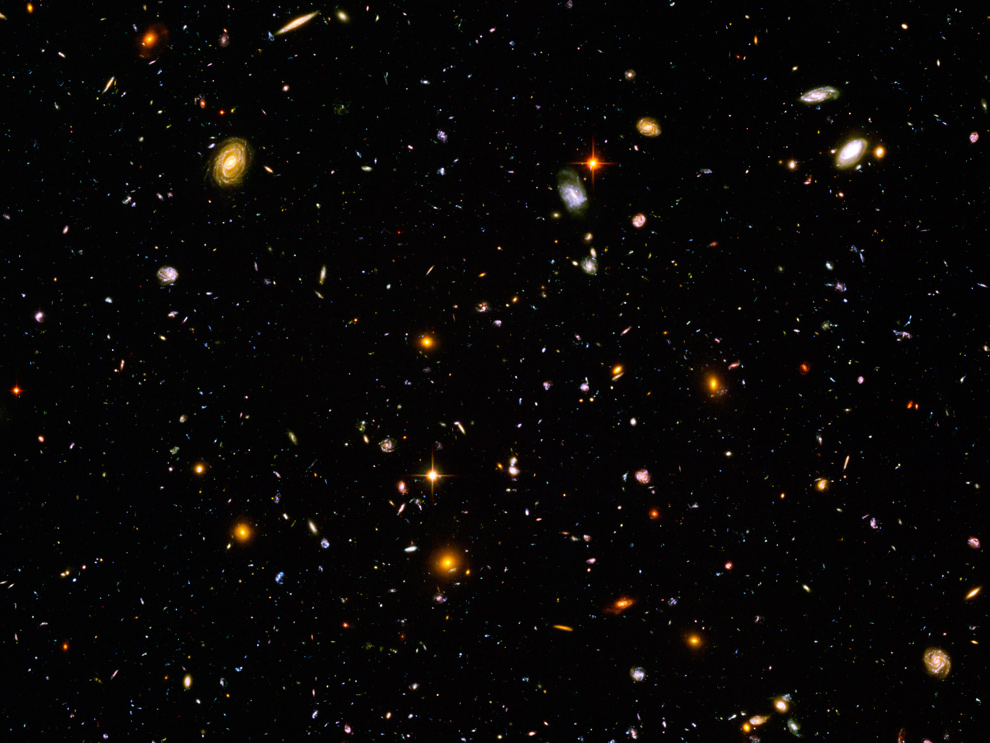
This is called the Hubble Ultra Deep Field. Starting in late 2003, astronomers pointed Hubble at a tiny, relatively empty part of our sky (only a few stars from the Milky Way visible), and created an exposure nearly 12 days long over a four-month period. The result is this amazing image, looking back through time at thousands of galaxies that range from 1 to 13 billion light-years away from Earth. Some 10,000 galaxies were observed in this tiny patch of sky (a tenth the size of the full moon) - each galaxy a home to billions of stars. -- Source
Looking at that picture brings in a perspective on how little we really are.

So, why not swing for the fences in the little time that we are here, because in a few years, nobody is going to care, whether we failed or not.

“Almost everything you do will seem insignificant, but it is important that you do it” -- Gandhi

Monday, December 21, 2009

The Wonder Years

This Calvin toon brought back some memories from school and college.


A running joke goes like this:
"Suppose you have only 1 hr to live. What would you do?" A prof. asks a student.
"I would go to college and sit in you class. It always feels like an eternity.".

I joined Chinmaya Vidyalaya in 3rd standard.
We were taken to school by Velayudhan, who would cram 11-13 kids in his auto-rickshaw. He was a nice guy because when he dropped us late and the principal shouted at the kids in English for being late, he would shout back in Malayalam, leaving the principal with no option.

In the first week at my new school, as we were standing in the assembly for a school prayer, a butterfly flew close by. Dileep, my new friend in the new school and I tried to catch it. Sadly, the vice principal saw it and summoned us to her room.

"I will bang your heads against each other if you repeat it" she shouted and told us to go back to classes.

A few years later, our school relocated further off and we had to take a couple of buses to reach the school.

Kacheripady was one stop before the final destination and a lot of school kids would be standing there waiting for the bus. The school principal used to see us as she traveled in her "Tempo Traveller" and she was angry one day that nobody standing there, acknowledged her.

"You must greet when our vehicle passes!" she ordered in the assembly session one day.
The next day, when the van passed, every school kid in the bus stop promptly shouted, "Haaaaaaaarriiiiii Om, Maam", in a tune, which was perhaps more embarrassing for her because she told us to stop it the next day.

High school was fun. Oh, I remember the buses "Maryland" and "Jithin", the last hope for those who want to reach school in time, which all of us late goers would wait for. It seemed the bus drivers somehow wanted to get us to school in time because they always drove like mad men and we, in the last seat in the bus had to hold on so as not to fall off. The bus would usually reach the place just 5 mins before the school call for assembly and then we would have a run to cover the kilometer long stretch from the bus stop to the school.

College was better. You only had to aim for 75% attendance which was still tough sometimes if some lectures always happened in the 8/9 AM time frame. 8 AM was hard to make if you wanted to eat breakfast too. But I had a trick up my sleeve, called the "last minute dash".
If I was late to the class, I would make a dash for the class in the last few meters up to the class and give an impression that I was literally "running" late. The professor would think that this guy ran to attend my class and feel good about and allow you to enter. Bonus Tip: If you come late, always pick the front seats.

There was one professor with initials "SP", who was a little strange. After entering the class, he would take attendance and then spend 10 mins cleaning the blackboard. It appeared he wanted the board to be as clean before he wrote anything. This often presented a good opportunity because when he was looking away, you could slip out of the class, something which we did often in his class. Sometimes, the room would be half empty once he finished cleaning the board but he usually didn't care.

My reading habits improved when I was in college because, it was more fun to read novels in class than hear lecturers read from text books.

Then, there was this guy called Prakash who was a repeater. Prakash was 2 years our senior. But he was the kind of guy who made it look "cool" to be a repeater. I liked Prakash. He used to be my companion in the back benches.

One day, someone dared him during a class. The dare was this: Walk up to the podium of the class, pat the lecturer on the back and then walk off the class.

Prakash's reputation was at stake. He thought about it for 5 mins. He got up, walked up to the podium where the lecturer was writing on the black board. And then, he patted on the back. The lecturer, taken unawares, was shocked. "What are you doing here?" he shouted.
But then Prakash whispered something to his ear and walked out. Later on he told us what he said: "I am not feeling well. Can I leave the class now?"